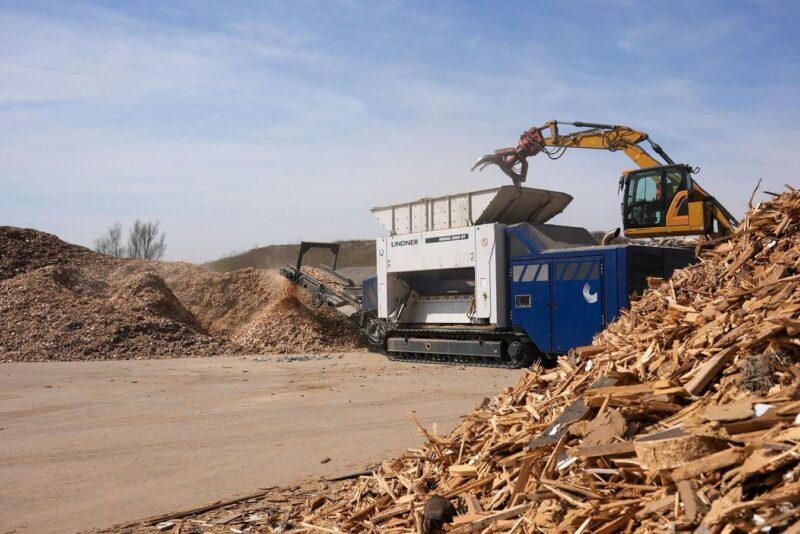
LINDNER’S WASTE WOOD DAYS 2019

Waste wood is no longer simply a material that needs to be disposed of.
When correctly processed, waste wood can become a valuable secondary raw material or a fuel for energy recovery.
But turning mixed or bulky waste wood into a consistent, usable product requires the right waste wood shredder.
The shredding process needs to deliver the required particle size, minimise unwanted fines, maintain high throughput and operate reliably despite the challenging nature of waste wood.
These were some of the key themes explored at Lindner’s Waste Wood Days 2019, where Lindner Recyclingtech demonstrated mobile system solutions designed to process waste wood efficiently for combustion applications.
The event showcased how combinations of Lindner Urraco and Miura shredders, together with Zeta Star screening technology, could be configured to produce defined waste wood fuel fractions in line with ISO 17225-1 requirements.
While the event took place in 2019, the fundamental challenge remains highly relevant today:
How do you turn waste wood into a consistent, high-quality product while keeping throughput high and operating costs under control?
What is Waste Wood Shredding?
Waste wood shredding is the process of mechanically reducing discarded or recovered wood into a controlled particle size suitable for its next application.
Depending on the material and end use, shredded waste wood can be used for:
- Energy recovery
- Biomass fuel
- Combined heat and power
- Material recovery
- Wood panel production
- Recycling
- Further processing
The required output depends heavily on the quality and classification of the incoming wood.
A shredder processing clean pallets for material recovery has different requirements from a machine processing bulky demolition timber for energy recovery.
This is why waste wood shredding technology needs to be selected around the end product.
Why is Waste Wood Processing Important?
Recovering waste wood correctly can provide both environmental and commercial benefits.
Instead of treating waste wood purely as a disposal material, effective processing can turn it into a usable resource.
Lindner identifies waste wood recycling as an important part of resource recovery, with the appropriate route depending on the contamination and classification of the material.
Depending on its characteristics, waste wood may be suitable for:
Material recovery
Suitable wood can be processed into material for products such as particleboard or chipboard.
Thermal recovery
Other waste wood streams may be processed into fuel for energy recovery.
Further processing
Shredded wood can also become an intermediate material for additional sorting, screening or size reduction.
The key is matching the processing technology to the material.
From Waste Wood to Fuel
One of the major applications for industrial waste wood shredding is fuel production.
Waste wood can be processed into defined particle sizes suitable for combustion systems.
For this application, simply reducing the volume of the material isn’t enough.
The finished fuel needs to meet the requirements of the downstream process.
Important characteristics include:
- Particle size
- Oversize content
- Fine fraction
- Moisture
- Contamination
- Material composition
- Throughput
- Consistency
A shredder that produces a large amount of fines or excessive oversize can create problems further down the line.
This is why controlled waste wood shredding is so important.
What is ISO 17225-1?
ISO 17225-1
provides classifications and specifications for solid biofuels.
For waste wood fuel production, the standard helps define particle-size characteristics and other requirements for the intended fuel.
Lindner’s waste wood solutions have been developed around producing defined particle sizes such as P63 and P100, depending on the application.
Typical particle classifications include:
| Classification | Main fraction | Maximum coarse fraction |
| P16 | <16 mm | 6% >31.5 mm |
| P45 | <45 mm | 10% >63 mm |
| P63 | <63 mm | 10% >100 mm |
| P100 | <100 mm | 10% >150 mm |
| P200 | <200 mm | 10% >250 mm |
The precise specification should always be assessed against the applicable standard, fuel application and customer requirements.
P63 Waste Wood
P63 is one of the particle-size classifications used for solid biofuel applications.
The main fraction is below approximately 63 mm, with limits applying to oversized particles.
Producing a consistent P63 fraction can require more than simply installing a smaller shredder screen.
The complete system needs to control:
- Shredding
- Screening
- Oversize
- Fines
- Material flow
Lindner’s system combining a Urraco 75 or Miura 1500 with a Zeta Star 75 F2 was designed to produce P63 material with less than 5% fines and throughput of up to approximately 20 tonnes per hour in the 2019 system configuration.
P100 Waste Wood
P100 is a larger particle-size classification.
Lindner demonstrated two approaches to producing P100 waste wood during Waste Wood Days 2019.
The first was a one-step system, using specially developed cutting technology on the Urraco 75 and Miura series.
The system was designed to produce P100 particles with a fines content below 4% in a single shredding stage.
The second approach combined an Urraco 95 DK with a Zeta Star 95 F2 DK screening system.
This configuration was designed for particularly high throughput applications and could produce a consistent P100 F05 output while separating fines and oversize material.
One-Step Waste Wood Shredding
One of the most interesting developments demonstrated at Waste Wood Days 2019 was the ability to produce a defined fuel fraction in a single shredding stage.
Traditionally, waste wood processing can involve:
Shredding → Screening → Re-shredding → Final product
A suitable one-step system can potentially simplify this:
Waste wood → Shredding → Finished fuel
The advantage is not simply fewer machines.
A successful one-step solution can potentially provide:
- Lower plant complexity
- Reduced material handling
- Lower footprint
- Reduced processing stages
- High throughput
- Consistent particle size
- Reduced operating costs
However, one-step processing isn’t appropriate for every waste wood application.
The correct solution depends on the incoming material and the required final specification.
Lindner Urraco for Waste Wood
The Lindner Urraco is a mobile twin-shaft shredder designed for high-throughput processing across a range of waste streams.
It is particularly relevant to waste wood applications where operators require a combination of:
- High throughput
- Mobility
- Robustness
- Flexible configuration
- Resistance to foreign materials
- Controlled output
The Urraco and Miura series were central to Lindner’s Waste Wood Days 2019 demonstrations, where they were configured for different waste wood processing requirements.
The technology has continued to evolve since 2019, with Lindner’s current mobile range including the Urraco EVO Series.
Lindner Miura for Waste Wood
The Lindner Miura is another mobile twin-shaft shredding platform designed for flexible waste processing.
At Waste Wood Days 2019, the Miura 1500 was demonstrated as part of a one-step P100 system and also in combination with screening technology for P63 production.
The ability to configure the machine around different materials and particle-size requirements is one of the important considerations when selecting mobile waste wood shredding equipment.
Why Fines Matter in Waste Wood Fuel
One of the biggest challenges in waste wood fuel production is controlling the amount of fine material.
Excessive fines can negatively affect downstream combustion and handling processes.
Lindner specifically identifies particle-size control as an important consideration when processing waste wood for energy recovery. Its technology has been developed to produce defined particle sizes while limiting unwanted fine fractions.
This matters because the objective isn’t simply:
Make the wood smaller.
It is:
Produce the right size, with the right proportion of fines and oversize, for the intended application.
Why Oversize Material Matters
Oversized pieces can also create problems.
Large particles can:
- Block conveyors
- Cause problems in feeding systems
- Reduce combustion consistency
- Require additional processing
- Increase material handling
- Reduce the usable proportion of the finished fuel
This is why screening can be an important part of a waste wood processing system.
A properly configured shredder and screen combination can separate material into usable fractions while returning oversize material for further processing where necessary.
Two-Stage Waste Wood Processing
While one-step shredding can be highly effective for suitable materials, some applications require two processing stages.
A typical system might involve:
Primary shredding → Screening → Secondary processing → Final fuel
The advantage is increased control.
A larger first-stage shredder can process bulky incoming material, while a downstream screen separates the material according to particle size.
Oversized material can then be returned for further size reduction.
This can be particularly useful where the incoming waste wood varies significantly in size or quality.
The Lindner Zeta Star Screening System
Screening can play an important role in producing consistent waste wood fuel.
The Lindner Zeta Star is designed to work alongside Lindner shredders to separate material into defined fractions.
At Waste Wood Days 2019, the Zeta Star was demonstrated in combination with both Urraco and Miura shredders.
The system incorporated adjustable star speed and hydraulic screen-deck adjustment, allowing the equipment to respond to changing input material.
This type of flexibility is particularly useful for waste processors dealing with variable feedstock.
High Throughput Waste Wood Shredding
Throughput is a critical consideration for commercial waste wood processors.
A machine may have excellent particle-size control, but if it cannot process enough material per hour, it may not meet the economics of the application.
Conversely, a machine with extremely high throughput isn’t necessarily the best solution if it produces too much oversize or fines.
The objective is to find the right balance between:
Throughput + particle size + fines + fuel quality + operating cost
Lindner’s 2019 demonstrations included systems capable of processing approximately 20–25 tonnes per hour for certain configurations, while the Urraco 95 DK and Zeta Star 95 F2 DK combination was designed for throughput exceeding 50 tonnes per hour.
Actual throughput depends on material composition, moisture, particle size, machine configuration and other operating conditions.
Waste Wood Shredding and Operating Costs
Processing costs are just as important as production rates.
A waste wood shredder consumes energy or fuel, requires wear components and needs regular maintenance.
Downtime also has a direct cost.
For that reason, the most efficient machine isn’t necessarily the one with the highest headline throughput.
Instead, operators should consider the total cost of producing each tonne of usable material.
Important factors include:
- Fuel or electricity consumption
- Wear-part consumption
- Maintenance
- Downtime
- Labour
- Material handling
- Screening
- Reprocessing
- Output quality
A machine that produces a higher proportion of usable fuel can potentially provide better economics even if its headline throughput isn’t the highest available.
Handling Foreign Materials
Waste wood can contain a surprising range of contaminants.
Depending on the source, material may include:
- Nails
- Screws
- Metal plates
- Glass
- Hard plastics
- Stones
- Other foreign objects
This makes foreign-material protection an important consideration when selecting a wood waste shredder.
Lindner’s mobile waste wood shredders incorporate systems designed to detect non-shreddable materials and release the shafts, helping protect the cutting system and drive components.
This can help reduce damage and improve machine availability.
Waste Wood Grades
Waste wood classification varies between countries and regulatory systems.
Lindner’s German waste wood guidance, for example, identifies four categories from A I to A IV, with increasing degrees of contamination and treatment.
Broadly, these categories range from relatively clean untreated wood through to more heavily treated material.
The classification is important because it can influence the appropriate end use.
Cleaner waste wood
Material with limited contamination may be suitable for material recovery and products such as wood panels.
Treated waste wood
More heavily treated or contaminated wood may be more appropriate for controlled thermal recovery, subject to the applicable regulations.
Operators should always establish the correct classification and legal requirements for the material in their jurisdiction.
Waste Wood Recycling for Material Recovery
Not all waste wood needs to become fuel.
Where the material is suitable, recovered wood can be processed for use in manufacturing.
Lindner identifies material recovery as one of the key routes for suitable waste wood, particularly where the material can be used in products such as chipboard.
For these applications, contamination control becomes particularly important.
Materials containing substances that could create environmental or health risks need to be appropriately identified and managed.
This means the waste wood processing system should be designed around the intended end use from the beginning.
Waste Wood for Energy Recovery
Where material isn’t suitable for material recovery, energy recovery may provide another route.
Shredded waste wood can be used as a fuel where the material meets the relevant requirements.
A controlled particle size helps downstream equipment handle and feed the material consistently.
This is why waste wood fuel production is increasingly focused on complete system design rather than simply choosing a shredder.
The shredder, screen, conveyors, separation equipment and fuel specification all need to work together.
Waste Wood Shredder or Chipper?
Waste wood shredders and wood chippers perform different functions.
A chipper is generally designed for relatively clean wood and uses knives to produce chips.
A waste wood shredder is typically designed for more varied and contaminated materials.
Industrial waste wood shredders may therefore be better suited to:
- Mixed waste wood
- Pallets
- Demolition timber
- Bulky wood
- Furniture
- Contaminated wood
- Treated timber
- Other difficult wood waste
The correct machine depends on the material and desired output.
Stationary or Mobile Waste Wood Shredder?
Another important consideration is whether the operation requires a stationary or mobile machine.
Mobile shredding
A mobile machine can be moved around the site or transported between locations.
This can be useful for:
- Multiple stockpiles
- Contract processing
- Transfer stations
- Demolition operations
- Flexible production
Stationary shredding
A stationary shredder is installed as part of a permanent processing line.
This can be advantageous where:
- High continuous throughput is required
- Material follows a fixed process
- Automated feeding is required
- Screening and separation are integrated into a complete plant
Lindner offers both mobile and stationary shredding technologies, allowing the equipment to be selected around the application.
Waste Wood Shredding in the UK
The UK waste wood market includes material from a wide range of sources, including:
- Construction
- Demolition
- Furniture
- Pallets
- Manufacturing
- Commercial waste
- Household waste
- Forestry and landscaping
Each stream can have different characteristics.
This makes application-specific machine selection particularly important.
A shredder designed for clean pallets may not be the right choice for mixed demolition wood.
Similarly, a machine designed for volume reduction may not produce the controlled particle size required for a fuel specification.
Choosing the Right Waste Wood Shredder
Before investing in a waste wood shredder, operators should consider several questions.
What material are you processing?
Identify the source, contamination level and typical material dimensions.
What is the required output?
Determine whether you need P63, P100, P200 or another specification.
Is the material being recycled or used as fuel?
The end use will influence the required processing system.
How much material needs to be processed?
Calculate the required tonnes per hour and annual tonnage.
How important is fines control?
Some applications have much stricter requirements than others.
Do you need one-step or two-stage processing?
A one-step solution may be appropriate for some applications, while others benefit from additional screening and processing.
Do you need a mobile or stationary system?
Consider whether the machine needs to move between materials or form part of a fixed processing line.
What support is available?
A shredder is a long-term investment. Parts, maintenance and engineering support should all be considered before purchase.
Mach Tech Services and Lindner Waste Wood Shredders
Mach Tech Services is the sole distributor for Lindner Recyclingtech in the UK and Ireland.
This gives UK and Irish waste processors access to Lindner’s range of mobile and stationary shredding technology for waste wood processing and other applications.
Depending on the requirements, solutions can include:
- Lindner Urraco
- Lindner Miura
- Lindner Polaris
- Lindner Jupiter
- Lindner Komet
- Lindner screening technology
The correct system depends on the feedstock, output specification and required throughput.
Mach Tech can support customers from initial application assessment through to installation and ongoing service.
Support includes:
- Application consultation
- Machine selection
- Installation
- Commissioning
- Preventative maintenance
- Repairs
- Precision engineering
- Welding
- Hardfacing
- Shredder rebuilds
- Spare and wear parts
Mach Tech also holds more than £1 million worth of spare and wear parts in stock, helping customers reduce downtime when components are required.
Why the Complete Waste Wood System Matters
One of the most important lessons from Lindner’s Waste Wood Days 2019 was that waste wood processing isn’t simply about the shredder.
The best results come from matching the complete system to the required output.
That can mean:
Shredder → Screen → Separation → Reprocessing → Finished fuel
Or, where the material allows:
Waste wood → One-step shredder → Finished product
The correct approach depends on the material and end use.
The objective is always the same:
Maximum usable output with minimum unnecessary processing.
The Future of Waste Wood Processing
The waste wood industry continues to place increasing emphasis on recovering value from materials that might previously have been treated simply as waste.
For processors, this creates an opportunity.
With the right shredding and screening technology, waste wood can be transformed into:
- Recovered raw material
- Biomass fuel
- Energy recovery fuel
- Consistent feedstock for downstream processes
The challenge is producing that material efficiently.
High throughput is important.
But so are particle size, fines, contamination, energy consumption, machine availability and operating costs.
Modern waste wood shredding systems are therefore becoming increasingly focused on complete process optimisation rather than simply maximum shredding power.
Lindner’s Waste Wood Days: A Technology Showcase That Still Matters
Lindner’s Waste Wood Days 2019 demonstrated what was possible when shredding and screening technology were designed around a specific end product.
The event showcased one-step P100 processing, two-stage P63 production and high-throughput P100 systems, demonstrating different approaches to producing controlled waste wood fuel fractions.
The technology has continued to develop since then, but the fundamental principles remain:
High throughput.
Controlled particle size.
Low fines.
Reliable operation.
Efficient fuel production.
For waste wood processors, those principles remain just as important today.
If you’re looking to invest in a waste wood shredder, improve your existing waste wood processing line or produce a more consistent wood fuel product, Mach Tech Services can help you identify the right Lindner solution for your application.
Call 01706 838246 or email sales@machtechservices.com to discuss your requirements.
Frequently Asked Questions
What is waste wood shredding?
Waste wood shredding is the mechanical processing of discarded or recovered wood into a smaller and more controlled particle size for recycling, material recovery or energy recovery.
What is the best shredder for waste wood?
The best waste wood shredder depends on the type of wood, contamination, required particle size, throughput and end use. Lindner offers mobile and stationary shredding systems that can be configured for different waste wood applications.
What can a waste wood shredder process?
Depending on the machine and configuration, waste wood shredders can process materials including pallets, furniture, bulky wood, demolition timber, mixed waste wood and other wood-based waste.
What is P63 waste wood?
P63 is a particle-size classification used for solid biofuels. The main fraction is below approximately 63 mm, with defined limits applying to oversized particles.
What is P100 waste wood?
P100 is a larger solid biofuel particle-size classification, with the main fraction below approximately 100 mm and defined limits for oversized material.
What is ISO 17225-1?
ISO 17225-1 is an international standard relating to solid biofuels and their specifications and fuel classes. It includes particle-size classifications relevant to waste wood fuel production.
Can waste wood be shredded in one step?
Yes. Certain waste wood streams can be processed to a defined fuel fraction in a single shredding stage. Lindner has developed Urraco and Miura configurations capable of producing P100 material in one step under suitable conditions.
What is the advantage of one-step waste wood shredding?
One-step processing can reduce the number of processing stages, material handling requirements and plant complexity. It can also provide an efficient route to a defined fuel fraction when the incoming material is suitable.
Why are fines important when shredding waste wood?
Excessive fines can negatively affect some combustion and handling processes. Controlling the fine fraction helps produce a more consistent fuel and can reduce unnecessary loss of usable material.
Why is oversize material a problem?
Excessive oversize can cause problems with conveyors, feeding systems and combustion equipment. It may also require additional processing before the material can be used.
Can a waste wood shredder produce biomass fuel?
Yes. Suitable waste wood can be processed into fuel for energy recovery. The required particle size and quality depend on the intended application and applicable fuel specification.
Can waste wood be recycled instead of burned?
Yes. Suitable waste wood can be recovered for material applications such as wood-panel production. The appropriate route depends on the material’s classification and contamination level.
What is the difference between a wood chipper and a waste wood shredder?
A chipper is generally designed for relatively clean wood, while an industrial waste wood shredder is designed to handle more varied and potentially contaminated material. The right machine depends on the feedstock and required output.
Should I choose a mobile or stationary waste wood shredder?
A mobile shredder can provide flexibility where material needs to be processed at different locations or stockpiles. A stationary shredder is often more suitable for a fixed, high-throughput processing plant.
Can waste wood contain metal?
Yes. Waste wood can contain nails, screws, metal plates and other foreign materials. Shredders designed for waste wood therefore need appropriate protection and foreign-material handling systems.
How much waste wood can a shredder process per hour?
Throughput varies according to the machine, material, moisture, particle size and configuration. Lindner’s demonstrated waste wood systems have included configurations ranging from around 20 tonnes per hour to more than 50 tonnes per hour, while other Urraco configurations can achieve substantially higher throughput depending on application.
What Lindner machines can process waste wood?
Lindner offers several machines suitable for waste wood applications, including the Urraco and Miura mobile shredders, as well as stationary systems such as the Polaris for suitable applications.
Can Mach Tech supply a waste wood shredder in the UK?
Yes. Mach Tech Services is the sole UK and Ireland distributor for Lindner Recyclingtech and supplies Lindner shredding technology for waste wood and other recycling applications.
Can Mach Tech design a complete waste wood processing system?
Yes. Mach Tech can help assess the incoming material, required throughput and final product specification before recommending an appropriate Lindner shredding and screening solution.
How do I discuss a waste wood shredding project?
Contact Mach Tech Services on 01706 838246 or email sales@machtechservices.com to discuss your waste wood processing requirements.
With their highly productive processing technologies, Lindner aims to transform waste wood into a profitable fuel.


The combination of a Urraco 75 shredder and the Zeta Star 75 F2 DK star screen means that clean P63 particles can be produced at a throughput of up to 20 metric tons per hour.

The combination of Lindner Urraco 95 DK and Zeta Star 95 F2 DK is designed for particularly high throughputs of over 50 metric tons per hour. The perfect match of shredder and screen ensures constant P100 F05 output.