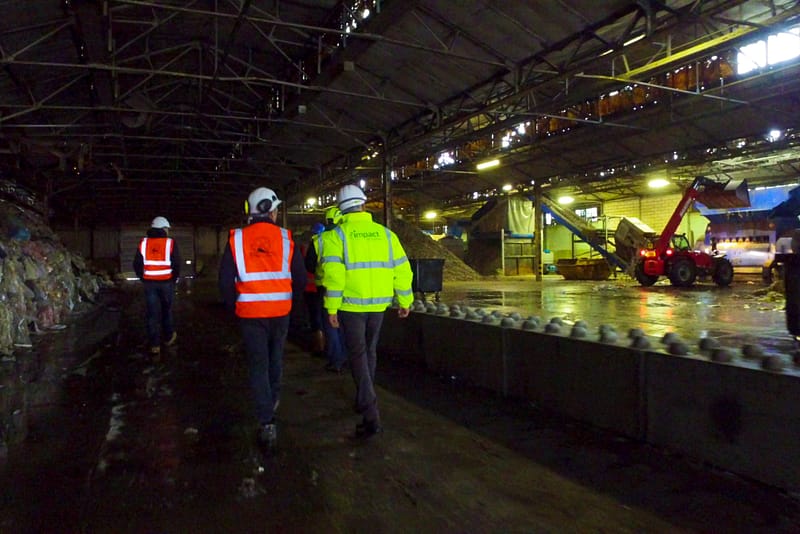
Lindner Polaris 2800, High-Performance RDF Processing for Cement Plants
Producing a consistent, high-quality refuse-derived fuel (RDF) requires powerful and reliable shredding technology.
For cement manufacturers, RDF can provide an important alternative to conventional fossil fuels, but the waste needs to be processed into a suitable fuel specification before it can be used in a calciner.
That is exactly where the Lindner Polaris 2800 comes into its own.
At Vassiliko Cement Works in Cyprus, associated company Enerco – Energy Recovery Ltd commissioned a Lindner Polaris 2800 to increase the capacity of its RDF production operation.
The results were significant.
After the machine had completed 950 operating hours, Enerco reported that the amount of local waste being treated had more than doubled, while average throughput was approximately 30% higher than the company had originally requested.
Producing alternative fuel for one of Europe’s largest cement plants
Located near Mari between Limassol and Larnaca, Vassiliko Cement Works is one of Cyprus’s largest industrial operations and one of Europe’s major cement plants.
The plant produces approximately 6,000 tonnes of clinker per day, creating a substantial demand for energy.
Enerco supplies the plant with alternative fuels produced from locally collected waste streams.
Rather than relying entirely on conventional fossil fuels, suitable waste materials can be processed into RDF and used as an alternative fuel within the cement manufacturing process.
This approach helps recover the energy value contained within waste while diverting suitable materials away from disposal.
The challenge: processing difficult waste streams
The material arriving at Enerco was far from straightforward.
The operation processes a mixture of challenging waste streams, including:
- End-of-life tyres
- Mixed waste
- Bulky waste
- Waste wood
- Other locally collected waste materials
These materials can be tough, bulky and inconsistent.
For an RDF production plant, the shredder therefore needs to be capable of handling heavy loads while maintaining consistent output.
A machine that struggles with difficult feedstock can quickly become a bottleneck in the entire RDF production process.
Enerco needed a solution capable of delivering the required fuel quality while also increasing overall processing capacity.
Why choose the Lindner Polaris 2800?
The Lindner Polaris 2800 is a single-shaft shredder specifically designed for high-performance one-step processing of untreated municipal, industrial and commercial waste.
Its primary applications include the production of medium-calorific RDF and SRF for use in cement works and thermal power plants.
Unlike a conventional multi-stage shredding process, the Polaris can produce a defined fuel fraction in a single shredding stage.
This can simplify the processing line and reduce the need for additional secondary shredding equipment.
For operations producing RDF for a cement plant calciner, this can offer significant advantages in terms of process efficiency and operating costs.
One-step RDF shredding
One of the defining features of the Polaris is its ability to process waste in a single step.
Untreated municipal, commercial and industrial waste can be fed into the machine, with the shredder producing a controlled output suitable for downstream fuel use.
Lindner’s current Polaris range is designed to produce mid-calorific fuels in the region of 40–120 mm, depending on the configuration and application.
For Enerco, the Polaris 2800 was configured to produce RDF at approximately 50 mm.
This material was then used as alternative fuel in Vassiliko Cement Works’ calciner.
More than doubling waste treatment capacity
The performance of the Polaris 2800 at Enerco was particularly impressive.
Following commissioning, the company reported that the amount of local waste streams treated had more than doubled.
This increase in processing capacity meant that significantly more locally generated waste could be converted into useful alternative fuel.
For an RDF producer, increasing throughput without compromising fuel quality is critical.
More tonnes processed per hour can mean:
- Greater production capacity
- Improved plant utilisation
- More RDF available for customers
- Reduced processing costs per tonne
- Greater recovery of energy from waste
Throughput exceeded expectations
The Polaris 2800 didn’t simply meet Enerco’s expectations.
It exceeded them.
After 950 operating hours, Enerco reported that the machine’s average throughput was approximately 30% higher than the requested specification.
This is particularly notable considering the nature of the feedstock.
The operation processes some extremely tough materials, meaning that the shredder needs to cope with significant mechanical loads while maintaining reliable performance.
The Polaris was designed specifically for this type of application.
Built for tough RDF applications
Producing RDF isn’t the same as processing a clean, uniform material stream.
Industrial and commercial waste can contain bulky items, heavy materials and unwanted foreign objects.
The shredder therefore needs to be robust enough to withstand demanding conditions.
The Polaris uses a low-speed, high-torque shredding principle, allowing its cutting system to apply substantial force to difficult waste materials. Lindner identifies resistance to foreign objects and robust construction as key characteristics of the machine.
This makes the Polaris particularly suitable for one-step RDF processing.
Why RDF is important for cement manufacturing
Cement production is energy intensive.
The clinker production process requires extremely high temperatures, creating significant energy demand.
Alternative fuels such as RDF can be used to replace a proportion of conventional fossil fuels in suitable cement plant applications.
The RDF produced by Enerco is used in Vassiliko Cement Works’ calciner, providing an alternative source of energy derived from waste.
This creates a useful connection between two industries:
Waste processing → RDF production → Alternative fuel → Cement manufacturing
Instead of simply disposing of suitable waste materials, their embedded energy can be recovered.
What is RDF?
Refuse-derived fuel, commonly known as RDF, is a fuel produced by processing suitable non-hazardous waste.
Depending on the production process and end-user requirements, waste can be sorted, shredded and processed into a fuel with defined characteristics.
RDF can contain materials such as plastics, paper, textiles and other combustible components recovered from commercial, industrial and municipal waste streams.
The aim is to produce a consistent fuel that can be used for energy recovery.
What is the difference between RDF and SRF?
RDF and SRF are both recovered fuels produced from waste, but they are not interchangeable terms.
RDF is generally used as a broader term for fuel produced from suitable waste.
Solid recovered fuel (SRF) is produced to more tightly defined quality specifications, including parameters such as particle size, moisture, ash and calorific value.
The appropriate shredding technology depends heavily on the required fuel specification and the intended end application.
For calciner applications, Lindner offers one-step solutions such as the Polaris alongside other configurations depending on the required fuel characteristics.
The importance of consistent fuel quality
High throughput is only part of the equation.
For an RDF producer supplying a cement plant, the fuel must also meet the requirements of the end user.
Particle size, composition and consistency can all influence how the material performs during combustion.
The Polaris 2800 is designed to produce a defined fuel fraction in one step, helping simplify the production process while maintaining the required material quality.
For Enerco, the target output from the Polaris 2800 was approximately 50 mm.
A more efficient approach to RDF production
Traditional waste processing systems can involve multiple shredding stages.
A primary shredder may initially reduce the waste before additional equipment further processes the material.
One-step shredding aims to simplify this process.
The Polaris was specifically developed to produce medium-calorific fuel from untreated waste in a single process step. Lindner states that this can make the overall process leaner and cheaper compared with comparable multi-stage approaches.
For high-volume RDF production, reducing the number of processing stages can potentially reduce:
- Capital expenditure
- Energy consumption
- Maintenance requirements
- Equipment footprint
- Labour requirements
- Process complexity
The exact benefits will depend on the feedstock, fuel specification and complete plant configuration.
Designed for continuous industrial operation
A commercial RDF plant cannot afford unnecessary downtime.
Every hour of lost production can mean tonnes of material that cannot be processed.
The Polaris has been designed for demanding continuous applications, with a robust construction and features intended to support reliable operation.
Its hydraulic maintenance door, for example, allows non-shreddable material to be removed quickly, helping minimise interruptions when unwanted material enters the shredder.
This focus on uptime is particularly important when the shredder forms a central part of a high-throughput RDF production line.
The Lindner Polaris 2800: key benefits
For operators looking for a high-capacity RDF shredder, the Polaris 2800 offers several key advantages:
One-step processing
Process suitable untreated waste into a defined fuel fraction in a single shredding stage.
High throughput
The Polaris 2800 is designed for high-volume industrial waste processing, with Lindner stating a potential capacity of up to 32 tonnes per hour depending on configuration and material.
High torque
Its low-speed, high-torque design provides the power required for demanding waste streams.
Robust construction
Designed to handle tough materials and foreign objects commonly encountered in untreated waste.
Controlled output
Screen selection allows the final particle size to be configured according to the application.
RDF and SRF applications
The Polaris is specifically designed around the production of recovered fuels for applications including cement plant calciners.
A proven solution for alternative fuel production
The Enerco installation demonstrates what can be achieved when high-performance shredding technology is matched to a demanding application.
The Lindner Polaris 2800 helped Enerco more than double the amount of local waste it could treat, while delivering average throughput approximately 30% above its requested specification.
The machine also produces approximately 50 mm RDF from challenging materials including end-of-life tyres, mixed waste, bulky waste and waste wood.
For Vassiliko Cement Works, that RDF provides a valuable source of alternative fuel for clinker production.
For Enerco, it means greater waste processing capacity.
And for the wider circular economy, it demonstrates how the energy contained within suitable waste can be recovered rather than simply discarded.
Frequently Asked Questions
What is the Lindner Polaris 2800?
The Lindner Polaris 2800 is a high-performance single-shaft industrial shredder designed for one-step processing of untreated municipal, commercial and industrial waste. It is particularly suited to producing RDF and SRF for applications including cement plant calciners.
What is the Lindner Polaris 2800 used for?
The Polaris 2800 is primarily used for one-step shredding of difficult waste streams to produce recovered fuels. Applications include RDF production for cement works, thermal power plants and other energy recovery facilities.
Can the Polaris 2800 produce RDF?
Yes. The Polaris is specifically designed for one-step RDF processing. Depending on the machine configuration and feedstock, it can produce a controlled fuel fraction suitable for downstream energy recovery.
What size RDF can a Polaris 2800 produce?
The Polaris range is designed to produce mid-calorific fuel in output sizes generally ranging from approximately 40–120 mm, depending on the configuration. In the Enerco application in Cyprus, the Polaris 2800 produced RDF at approximately 50 mm.
How much can a Polaris 2800 shred per hour?
Lindner states that the Polaris 2800 can achieve volumes of up to approximately 32 tonnes per hour, depending on the material and configuration. Actual throughput will vary according to feedstock, density, contamination, moisture and required output specification.
Can the Polaris 2800 process tyres?
Yes. The Enerco installation in Cyprus processes end-of-life tyres alongside mixed and bulky waste and waste wood to produce alternative fuel.
Why use RDF in a cement plant?
RDF can be used as an alternative fuel in suitable cement manufacturing applications, helping replace a proportion of conventional fossil fuels. The Enerco RDF produced by the Polaris 2800 is used in the calciner at Vassiliko Cement Works.
What is one-step shredding?
One-step shredding means reducing suitable untreated waste to the required fuel fraction using a single primary shredding process rather than relying on separate primary and secondary shredders. The Polaris was specifically developed around this approach.
Is the Polaris 2800 suitable for SRF production?
The Polaris can be used in recovered-fuel applications, although the correct shredding technology depends on the required SRF specification and the characteristics of the feedstock. Lindner offers several shredding configurations for alternative-fuel production.
Who supplies Lindner Polaris shredders in the UK?
Mach Tech Services is the sole UK and Ireland distributor for Lindner Recyclingtech shredders, providing sales, installation, servicing, repairs, parts and engineering support.
Looking for an RDF shredder?
If you’re producing RDF or SRF for a cement plant, energy-from-waste facility or other thermal recovery application, selecting the right shredder can have a major impact on throughput, fuel quality and operating costs.
Mach Tech Services can help assess your waste stream, required output and production targets to identify the most suitable Lindner RDF shredding solution.
Call Mach Tech Services on 01706 838 246 to discuss your application or arrange a site visit.
Find Your Ideal Shredding Solution, Speak to Our Experts
Looking for the right setup for your operation or need guidance on applications, throughput or particle size? Our specialists are here to help.
Whether you’re exploring the capabilities of the Lindner range or comparing shredding solutions, we’ll work with you to identify the best fit for your needs.
Call us today on 01706 838 246, or get in touch for expert advice, pricing, or to arrange a site visit.
You can also use the form to send your enquiry and a member of our team will be in touch shortly.
"*" indicates required fields