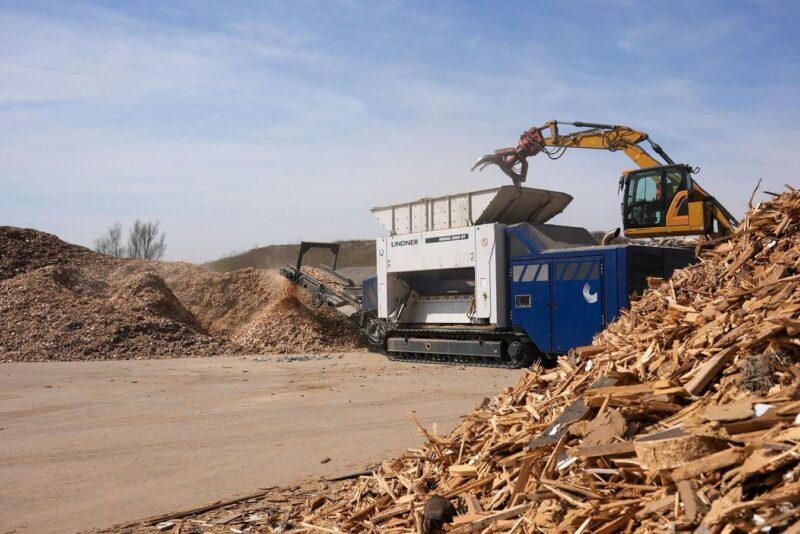
The Brand New Lindner Polaris

The
Lindner Polaris shredder
was developed to solve a specific challenge in the waste and recycling industry: how to process demanding waste streams into a consistent recovered fuel efficiently, using as few processing stages as possible.
When the Polaris was first introduced to the UK market, it represented a significant development in one-step shredding technology.
North West Recycling became the first company in the UK to install a Lindner Polaris after working with Mach Tech Services and Lindner Recyclingtech to identify a solution capable of delivering high throughput, minimising oversize material and producing a suitable feedstock for Solid Recovered Fuel (SRF) production.
Today, the Polaris has established itself as a specialist single-shaft shredder for one-step processing, with the current range including the Polaris 1800, Polaris 2200 and Polaris 2800. The machines are designed for processing untreated municipal, commercial and industrial waste into defined recovered fuel fractions.
What is the Lindner Polaris Shredder?
The Lindner Polaris is a highly specialised single-shaft industrial shredder designed for one-step processing of suitable waste streams.
Unlike a conventional multi-stage waste processing system, the Polaris can be used to reduce suitable incoming material to a defined fuel fraction in a single shredding stage.
This makes the machine particularly relevant to applications involving:
- Solid Recovered Fuel (SRF)
- Refuse Derived Fuel (RDF)
- Alternative fuel production
- Municipal waste
- Commercial waste
- Industrial waste
- Mixed combustible waste
Lindner describes the Polaris as a machine developed for one-step processing of untreated municipal, industrial and commercial waste, producing mid-calorific fuels in the region of 40–120 mm, depending on configuration and application.
The key principle is simple:
Waste → One-step shredding → Controlled fuel fraction
For suitable applications, this approach can reduce the number of processing stages required and simplify the overall plant configuration.
Why Was the Polaris Developed?
Producing SRF or RDF isn’t simply about shredding waste as quickly as possible.
Waste processors need to consider:
- Throughput
- Particle size
- Fuel quality
- Contamination
- Energy consumption
- Wear costs
- Maintenance
- Downtime
- Cost per tonne
Traditional waste processing systems may require multiple stages of shredding and material handling to achieve the desired output.
Lindner developed the Polaris around a different approach.
The objective was to create a machine capable of processing suitable waste into a defined fuel fraction in one step, while maintaining high throughput and controlling operating costs.
Lindner continues to position the Polaris around cost-efficient, reliable one-step processing for recovered fuel applications.
The First Lindner Polaris in the UK
The introduction of the Polaris into the UK market began with North West Recycling at its facility at Kingmoor Park in Carlisle.
North West Recycling operates alongside sister company Brampton Skip Hire and had been looking for ways to improve its recycling operation and the products it produced from recovered waste.
In 2016, the company approached Mach Tech Services with a specific requirement.
The brief was to find a machine that could:
- Maximise throughput
- Minimise oversize material
- Produce a consistent output
- Prepare material for SRF production
- Reduce processing costs
- Provide a one-step shredding solution
At the time, Lindner was developing a new machine specifically around these requirements.
That machine was the Polaris.
North West Recycling subsequently became the first company in the UK to install the Lindner Polaris, creating an important milestone for North West Recycling, Mach Tech and Lindner.
A New Approach to One-Step Waste Shredding
The concept behind the Polaris was straightforward.
Rather than using multiple shredding stages to progressively reduce the material, the machine was designed to perform the required size reduction in one process.
A traditional system might look like:
Primary shredder → Separation → Secondary shredder → Final fuel
A suitable one-step application could instead use:
Waste → Polaris → Final fuel fraction
This can provide several potential benefits.
Reduced process complexity
Fewer processing stages can simplify the overall plant layout.
Reduced material handling
Every additional processing stage can require conveyors, transfers and additional equipment.
Lower equipment requirements
Where a one-step process is suitable, a separate secondary shredder may not be required.
Reduced footprint
A simpler process can potentially reduce the physical footprint of the processing system.
Lower operating costs
Reducing the number of processing stages can potentially reduce electricity consumption, maintenance and labour requirements.
The exact benefits depend on the waste stream and required fuel specification, but the principle behind the Polaris is to make suitable recovered-fuel processing leaner and more efficient.
How Does the Lindner Polaris Work?
The Polaris is a single-shaft, low-speed, high-torque shredder.
This combination is important when processing demanding waste streams.
Instead of relying on extremely high rotor speeds, the machine uses substantial torque to pull and process material through the cutting system.
This allows it to handle challenging materials while maintaining a controlled output.
The current Polaris range incorporates an internal pusher system to support safe and controlled feeding, while the hydraulic maintenance door provides access to the cutting system and allows foreign materials to be removed efficiently.
Producing a Consistent Fuel Fraction
High throughput is only valuable if the resulting material meets the requirements of the application.
For SRF and RDF production, particle size and consistency can have a significant impact on downstream handling and fuel quality.
The Polaris uses configurable screen technology to control the final output.
Current Lindner information identifies output in the 40–120 mm range, depending on the machine configuration, screen selection and application.
This allows operators to configure the machine around the requirements of the final fuel user.
The objective is not simply to produce smaller material.
It is to produce the right material.
Why Consistent Output Matters for SRF
SRF is produced from suitable non-hazardous waste and is used as an alternative fuel in applications such as cement manufacturing and other energy recovery processes.
The final fuel needs to meet the requirements of its intended application.
That can involve considerations such as:
- Particle size
- Calorific value
- Moisture
- Chlorine
- Contamination
- Physical composition
The shredder therefore plays a critical role in the production process.
A machine that produces a consistent, controlled output can help make subsequent handling and fuel preparation more predictable.
The Polaris was specifically developed around this requirement, with the ability to produce defined output fractions in a single shredding stage.
Independent Testing of the Polaris
Following the installation at North West Recycling, the Polaris was subjected to an independent testing programme by academics from Montan University in Austria.
The testing was designed to assess the performance of the machine and its one-step shredding technology.
The results provided additional confidence in the machine’s performance and supported North West Recycling’s decision to invest in the technology.
Independent testing can be particularly valuable when introducing new technology into a waste processing environment.
For operators, performance needs to be demonstrated in the real world, rather than simply evaluated through manufacturer specifications.
The Economics of One-Step Shredding
For a waste processing business, the cost of producing every tonne matters.
A multi-stage processing system can involve additional:
- Shredders
- Conveyors
- Electrical equipment
- Wear parts
- Maintenance
- Labour
- Floor space
- Material handling
Where a one-step process is technically suitable, removing one or more processing stages can potentially simplify the operation and reduce the overall cost per tonne.
This is one of the fundamental principles behind the Polaris.
Lindner positions the machine as a cost-efficient solution for one-step recovered-fuel production, with the aim of maintaining high throughput while controlling operating costs.
Designed for Continuous Operation
Downtime is one of the biggest costs facing waste processing companies.
When a shredder stops, the consequences can extend far beyond the machine itself.
Production can stop.
Sorting equipment can become idle.
Labour continues to incur costs.
Customer commitments can be affected.
And the entire processing line can become disrupted.
The Polaris was designed with continuous industrial operation in mind.
Lindner describes the machine as suitable for uninterrupted operation 24 hours a day, seven days a week, depending on the application and operating conditions.
This focus on uptime is particularly important for high-throughput SRF and RDF production facilities.
Protection Against Foreign Materials
Waste streams are unpredictable.
Even well-controlled input material can contain objects that shouldn’t be entering a shredder.
Foreign and non-shreddable materials can potentially cause significant damage to cutting systems and drive components.
The Polaris incorporates a safety clutch designed to protect the drive system when non-shreddable material enters the machine.
The hydraulic maintenance door also provides controlled access to the cutting chamber, helping operators remove unwanted material efficiently while minimising unnecessary downtime.
This is particularly important when processing untreated or mixed waste.
Maintenance and Accessibility
Maintenance is an important consideration when selecting any industrial shredder.
A machine can be powerful and productive, but if servicing is unnecessarily difficult, maintenance costs can increase and downtime can become more disruptive.
The Polaris incorporates features designed to provide straightforward access to critical components.
The hydraulic maintenance door allows access to the cutting system for inspection, servicing and removal of foreign material.
The cutting system also uses four-fold usable knives, helping operators make efficient use of wear components and reduce unnecessary replacement costs.
Polaris 1800, 2200 and 2800
The Polaris is available in several machine sizes to suit different processing requirements.
The current range includes:
Polaris 1800
A compact member of the Polaris range designed for one-step recovered-fuel processing.
Polaris 2200
A larger configuration designed for higher-capacity applications.
Lindner’s published specifications identify the Polaris 2200 as capable of processing up to approximately 22 tonnes per hour, depending on the material and operating conditions.
Polaris 2800
The largest model in the range, designed for high-throughput applications.
Lindner’s published information identifies the Polaris 2800 as capable of processing up to approximately 32 tonnes per hour, depending on material and configuration.
Actual throughput will always depend on factors such as:
- Material composition
- Moisture
- Density
- Contamination
- Feed preparation
- Screen configuration
- Required output size
- Operating conditions
Machine selection should therefore be based on the complete application rather than headline throughput alone.
Polaris for RDF Production
Although the Polaris is strongly associated with SRF production, it can also be used for Refuse Derived Fuel (RDF) applications.
RDF is produced by processing suitable residual waste into a fuel for energy recovery.
Depending on the application, RDF may be used in:
- Energy-from-waste facilities
- Industrial energy recovery
- Cement manufacturing
- Other suitable thermal applications
The Polaris provides a one-step approach for suitable RDF applications where the incoming waste and final fuel specification allow it.
This makes it an attractive option for operators looking to simplify their RDF processing system.
Polaris for Cement Plant Fuel
One of the key applications for recovered fuels is use within cement manufacturing.
Lindner identifies the Polaris as particularly suitable for producing mid-calorific fuels for co-incineration in cement works and calciners.
This creates an important link between waste processing and industrial energy recovery.
Instead of treating suitable combustible waste purely as a disposal problem, it can be processed into a usable alternative fuel.
The quality of that fuel, however, depends on the complete processing system.
The shredder is one important part of that system.
One-Step vs Two-Stage Shredding
Not every waste stream should automatically be processed through a one-step shredder.
For some applications, a multi-stage process remains the better option.
One-step shredding
A Polaris can be particularly attractive when:
- The material is suitable for one-step processing
- A defined fuel fraction is required
- High throughput is important
- A simpler plant configuration is preferred
- Reduced material handling is desirable
- Operating costs need to be controlled
Two-stage shredding
A primary and secondary shredding system may be more appropriate when:
- The incoming material is particularly difficult
- Significant separation is required
- Different stages need different particle sizes
- A more refined final output is required
- The process requires staged size reduction
There is no universal solution.
The right approach depends on the material, plant design, throughput and final fuel specification.
Mach Tech can assess the application and help determine whether a Polaris one-step solution or a multi-stage Lindner system is more appropriate.
Why North West Recycling Chose the Polaris
The original requirement from North West Recycling was clear:
Maximum throughput. Minimum oversize. Consistent SRF production.
The Polaris was developed around these exact requirements.
Rather than installing a conventional multi-stage shredding system, the company invested in a machine capable of achieving the required size reduction through one shredding stage.
The result was a significant development in the company’s processing operation and an important introduction of Lindner’s Polaris technology to the UK market.
Mach Tech and the Lindner Polaris
Mach Tech Services played a central role in bringing the Polaris to the UK market.
As Lindner’s UK and Ireland distributor, Mach Tech worked with North West Recycling throughout the process, from the initial investigation into one-step shredding through to the installation and introduction of the new technology.
The project brought together:
North West Recycling’s application requirements + Mach Tech’s UK shredding expertise + Lindner’s engineering technology
That relationship remains important today.
Mach Tech supports customers across the complete lifecycle of their Lindner shredding equipment, from initial machine selection through to installation, commissioning, maintenance, repairs, engineering and spare parts.
Why Choose Mach Tech for a Lindner Polaris?
Choosing an industrial shredder is a major investment.
The machine itself is only one part of the decision.
Operators should also consider the support available after installation.
Mach Tech provides:
- Application advice
- Machine selection
- Site assessments
- Installation
- Commissioning
- Preventative maintenance
- Breakdown support
- Genuine spare parts
- Wear parts
- Precision engineering
- Welding
- Hardfacing
- Shredder rebuilds
Mach Tech also holds more than £1 million worth of spare and wear parts in stock, helping customers reduce delays and minimise unnecessary downtime.
This means customers aren’t simply buying a machine.
They’re gaining access to ongoing technical and engineering support throughout the machine’s operating life.
The Lindner Polaris Today
Since its original introduction, the Polaris has become an established solution for one-step recovered-fuel processing.
The current Polaris range includes the 1800, 2200 and 2800, providing different machine sizes for different throughput and application requirements.
The technology continues to be used across SRF, RDF and alternative-fuel applications where operators are looking for a combination of:
- High throughput
- Controlled output
- One-step processing
- Reliable operation
- Low operating costs
- Straightforward maintenance
The fundamental concept remains the same as when the Polaris was first introduced:
Process suitable waste efficiently, in one step, into a valuable recovered fuel.
Looking for a One-Step SRF or RDF Shredder?
If you’re considering a new SRF or RDF processing line, upgrading an existing shredder or looking for an alternative to a multi-stage system, the Lindner Polaris could provide an efficient solution for your application.
However, the right machine depends on your waste stream, required throughput, target particle size and final fuel specification.
Mach Tech can assess your requirements and help determine whether the Lindner Polaris 1800, Polaris 2200, Polaris 2800 or another Lindner shredding technology is the right solution.
01706 838246
sales@machtechservices.com
Frequently Asked Questions
What is the Lindner Polaris shredder?
The Lindner Polaris is a specialised single-shaft industrial shredder designed for one-step processing of untreated municipal, commercial and industrial waste. It is particularly suited to SRF, RDF and alternative-fuel production.
What is the Lindner Polaris used for?
The Polaris is primarily used for one-step waste shredding and recovered-fuel production. Applications include SRF production, RDF production and alternative fuel processing for applications such as cement works and energy recovery.
What is one-step waste shredding?
One-step waste shredding is a process where suitable incoming waste is reduced to the required fuel fraction in a single shredding stage. This can potentially simplify the processing line by reducing the number of size-reduction stages required.
What size output can a Lindner Polaris produce?
The current Polaris range is designed to produce mid-calorific fuel in the region of 40–120 mm, depending on machine configuration, screen selection and application.
Is the Lindner Polaris suitable for SRF production?
Yes. The Polaris was specifically developed for one-step processing of suitable waste into solid recovered fuel and other recovered-fuel fractions. Lindner identifies the production of medium-calorific SRF as a key application for the machine.
Is the Polaris suitable for RDF production?
Yes. The Polaris can be used for suitable RDF applications where the incoming waste and required fuel specification are compatible with one-step processing.
What is the difference between RDF and SRF?
RDF stands for Refuse Derived Fuel and is a broad term for fuel produced from suitable waste materials.
SRF stands for Solid Recovered Fuel and is generally produced to more controlled specifications relating to factors such as particle size, moisture, calorific value and contaminants.
The appropriate shredding process depends on the waste stream and requirements of the final fuel user.
How much can a Polaris shred per hour?
Throughput depends on the model, material and operating conditions.
The published Lindner figures identify the Polaris 2200 at up to approximately 22 tonnes per hour and the Polaris 2800 at up to approximately 32 tonnes per hour, depending on the application.
Actual performance will depend on factors including waste composition, moisture, density, contamination and required output size.
What is the Polaris 2800?
The Polaris 2800 is the largest model in the current Polaris range. It is designed for high-throughput one-step processing of suitable municipal, commercial and industrial waste and can produce defined recovered-fuel fractions.
What is the difference between the Polaris 1800, 2200 and 2800?
The three models are different sizes within the Polaris range, allowing operators to select a machine according to their required throughput and application.
The Polaris 1800 provides a more compact configuration, while the 2200 and 2800 are designed for progressively higher-capacity applications.
The correct model should be selected based on the actual material and required production rate rather than machine size alone.
Is the Polaris a single-shaft shredder?
Yes. The Lindner Polaris is a single-shaft shredder specifically developed for one-step processing applications.
Can the Polaris process untreated waste?
Yes. The Polaris was specifically developed to process suitable untreated municipal, commercial and industrial waste into a defined recovered-fuel fraction.
How does the Polaris handle foreign materials?
The Polaris incorporates a safety clutch designed to protect the drive when non-shreddable material enters the machine. Its hydraulic maintenance door also provides controlled access to the cutting system, allowing foreign material to be removed efficiently.
What are the benefits of one-step SRF shredding?
Potential benefits include reduced process complexity, fewer processing stages, less material handling, a smaller plant footprint and potentially lower operating costs.
Whether these benefits can be achieved depends on the incoming material and final fuel specification.
Is one-step shredding always better than two-stage shredding?
No. One-step processing is highly effective for suitable applications, but some waste streams require primary shredding, separation and secondary shredding to achieve the required fuel specification.
The best approach depends on the material, throughput, contamination, particle-size requirements and downstream process.
How important is shredder maintenance?
Maintenance is critical to maintaining machine availability, output quality and operating efficiency.
Regular inspection, preventative maintenance and timely replacement of wear components can help reduce unplanned downtime and extend the operating life of the shredder.
Who supplies Lindner Polaris shredders in the UK?
Mach Tech Services is the sole UK and Ireland distributor for Lindner Recyclingtech shredders
, providing Polaris machines alongside Lindner’s wider range of primary, secondary, universal and mobile shredding technology.
Can Mach Tech help me choose the right Polaris?
Yes. Mach Tech can assess your waste stream, throughput requirements, required output and overall processing application to determine whether a Polaris is suitable and which configuration is most appropriate.
Mach Tech can also provide installation, commissioning, maintenance, engineering and spare-parts support.