Turning waste into a reliable source of energy requires more than simply shredding material.
A successful SRF production plant needs to combine shredding, separation, screening, conveying and material handling technologies to produce a consistent fuel suitable for industrial applications.
ThermoTeam Alternativbrennstoffverwertungs GmbH in Styria, Austria, provides a strong example of what can be achieved.
Fifteen years after beginning production, the ThermoTeam facility had produced an incredible 1 million tonnes of solid recovered fuel (SRF) from mixed municipal and industrial waste. The complete processing line was designed by Lindner Recyclingtech.
The SRF produced at the facility is largely used at the neighbouring Retznei cement works, replacing conventional fossil fuels in the cement manufacturing process.
What Is SRF?
Solid Recovered Fuel (SRF) is a processed waste-derived fuel produced from suitable non-hazardous waste.
The aim is to recover the energy contained within waste that cannot be economically or practically recycled as a material.
Depending on the feedstock and required specification, SRF production can involve:
- Primary shredding
- Secondary shredding
- Screening
- Ferrous metal separation
- Non-ferrous metal separation
- Air separation
- Conveying
- Material dosing
- Quality control
The final fuel can then be used in suitable industrial combustion applications, including cement manufacturing.
From Mixed Waste to Solid Recovered Fuel
The ThermoTeam facility was designed to process mixed municipal and industrial waste into a high-calorific SRF.
The original facility began operation in June 2003 and had produced one million tonnes of SRF by the time of its 15-year anniversary in 2018.
The processing concept demonstrates how waste can be transformed into a valuable alternative fuel.
The basic process:
Mixed Waste
↓
Primary Shredding
↓
Material Separation
↓
Secondary Shredding
↓
Fuel Preparation
↓
Solid Recovered Fuel
↓
Cement Manufacturing
This approach allows suitable waste materials to be diverted from disposal while recovering their energy value.
Lindner Designed the Complete SRF Processing Line
One of the most significant aspects of the ThermoTeam project is that Lindner Recyclingtech was involved from the planning stage through to production, assembly, commissioning and initial operation.
Rather than supplying an individual shredder in isolation, Lindner designed the complete processing line.
The system incorporated:
- Primary shredders
- Secondary shredders
- Ferrous separators
- Non-ferrous separators
- Wind sifters
- Feeding systems
- Conveyor systems
- Discharge belts
This integrated approach demonstrates why successful SRF production depends on the interaction between multiple stages of processing.
The Importance of Primary Shredding
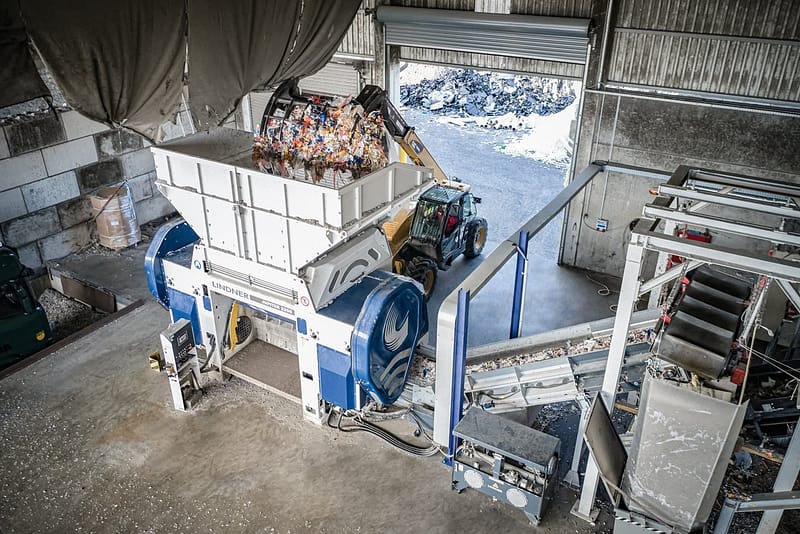
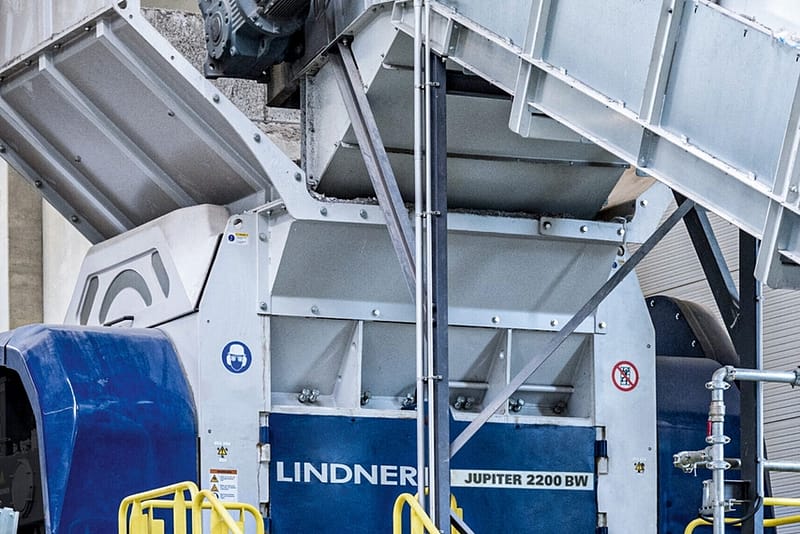
At the beginning of the ThermoTeam process is a Lindner Meteor stationary primary shredder.
The Meteor was the predecessor to Lindner’s Jupiter series and had accumulated more than 70,000 operating hours at the time of the original case study. It had processed approximately 1 million tonnes of input material over ten years.
Primary shredding is essential because incoming waste can be:
- Bulky
- Mixed
- Irregularly shaped
- Contaminated
- Difficult to handle
Reducing the material to a more manageable size creates a more consistent feed for downstream separation and processing equipment.
Shredding Technology for Difficult Waste
SRF production plants need to be able to handle variable feedstock.
Mixed municipal and industrial waste can contain unwanted materials and foreign objects that could potentially damage conventional processing equipment.
The original ThermoTeam case study highlights the ability of Lindner shredders to cope with foreign objects and difficult materials. The machines also feature a hydraulic maintenance door designed to provide access for removing foreign objects and cleaning the machine.
This is an important consideration when designing an SRF shredding system.
Reliability isn’t simply about processing the ideal material.
It’s about continuing to operate when real-world waste inevitably contains unexpected objects.
Recovering Materials Before SRF Production
SRF production doesn’t necessarily mean sending everything through the shredder and turning it into fuel.
A well-designed system can recover recyclable materials before or during fuel preparation.
At ThermoTeam, the sorting system positioned after the primary shredders had recovered approximately:
27,000 tonnes of scrap metal
and
5,000 tonnes of PET plastic waste
according to the original case study.
This illustrates an important principle of modern waste processing:
Recover recyclable materials first. Recover energy from the remaining suitable waste.
SRF Production for the Cement Industry
One of the main applications for the SRF produced at ThermoTeam is the neighbouring Retznei cement works.
The SRF replaces conventional fossil fuels such as coal or lignite in the cement manufacturing process.
This provides a route for waste-derived fuel to contribute to industrial energy requirements.
For cement manufacturers, alternative fuels can provide an opportunity to reduce dependence on conventional fossil fuels while recovering energy from suitable waste streams.
The Environmental Benefits of SRF
The ThermoTeam project also demonstrates the potential environmental benefits of replacing fossil fuels with SRF.
The original article cites research from Joanneum Research in Graz, which found that using one tonne of SRF instead of coal could reduce carbon dioxide emissions by approximately two tonnes under the conditions studied. The case study states that Lafarge had therefore saved approximately 1.2 million metric tonnes of CO₂ over the preceding ten years.
The wider benefits of SRF production can include:
- Reduced reliance on fossil fuels
- Energy recovery from residual waste
- Recovery of recyclable metals
- Reduced waste sent for disposal
- Support for circular-economy principles
Actual environmental performance will depend on the waste stream, fuel specification, combustion process and overall system.
A High-Capacity SRF Production Facility
The ThermoTeam facility originally had a production capacity of approximately:
100,000 tonnes of SRF per year
The company planned to increase this to approximately 118,000 tonnes per year, alongside further investment in the plant.
At this scale, reliability and throughput become critical.
A small amount of downtime can quickly translate into a significant loss of production capacity.
This makes the choice of shredding equipment particularly important.
The Lindner Komet HP 2200
As demand increased, Lindner supplied a Komet HP 2200 to replace two older stationary secondary shredders at the facility.
The Komet HP is designed for demanding secondary shredding applications where high throughput and consistent output are required.
Within an SRF production line, secondary shredding can help bring the material towards the particle size and specification required by the final fuel application.
This highlights the importance of using different shredding stages for different purposes.
Primary Shredder
Handles large, mixed incoming waste.
Secondary Shredder
Refines the material towards the required fuel specification.
Why Particle Size Matters in SRF Production
The particle size of SRF is an important consideration.
The required specification depends on factors such as:
- Fuel feeding system
- Cement kiln configuration
- Combustion technology
- Material composition
- Fuel specification
- Storage requirements
A well-designed SRF production line therefore needs to provide control over the material throughout the process.
The combination of primary and secondary shredding allows operators to progressively reduce and refine the waste rather than relying on a single machine to perform every stage.
SRF Quality and Consistency
Producing SRF is about more than achieving maximum throughput.
The fuel needs to meet the requirements of its intended end user.
Important characteristics can include:
Calorific Value
The energy content of the fuel.
Moisture
High moisture can affect combustion efficiency and handling.
Particle Size
The fuel must be suitable for the feeding and combustion system.
Chlorine
Chlorine levels can be an important consideration for cement plants and other combustion applications.
Contamination
Unwanted materials can affect fuel quality and plant operation.
Composition
A consistent feedstock helps produce a more predictable fuel.
This is why SRF production equipment needs to be considered as a complete processing system.
SRF vs RDF: What’s the Difference?
The terms RDF and SRF are often used together, but they aren’t necessarily interchangeable.
RDF — Refuse Derived Fuel
A broad term for fuel produced from waste.
SRF — Solid Recovered Fuel
A more specifically defined category of processed waste-derived fuel that is produced to controlled quality specifications.
Both can be used for energy recovery, but the exact specification and application will determine which fuel is appropriate.
For cement plants, fuel consistency and quality are particularly important.
The Role of Sorting in SRF Production
Sorting technology can make a major contribution to an efficient SRF production plant.
By separating recyclable materials from the incoming waste, operators can:
- Recover metals
- Recover plastics
- Reduce contamination
- Improve fuel quality
- Increase resource recovery
- Prepare the remaining material for fuel production
ThermoTeam’s system incorporated both ferrous and non-ferrous separation, alongside a wind sifter and other processing equipment.
This creates a more sophisticated process than simply shredding waste for fuel.
The Future of SRF Production
The ThermoTeam plant also became a test and pilot facility for the ReWaste 4.0 research project.
The project, led by the University of Leoben, focused on making mixed waste treatment more efficient and increasing material recycling rates.
The research included technologies such as:
- Sensor-based sorting
- Contactless sorting
- Robotics
- Digital connectivity
- More efficient waste treatment
The objective was to develop waste processing systems capable of recovering more materials while improving overall efficiency.
This is particularly relevant as the recycling industry moves towards increasingly automated and data-driven processing plants.
What Makes a Good SRF Production Plant?
A successful SRF production facility needs to balance several competing requirements.
High Throughput
The plant must process sufficient quantities of waste to meet production targets.
Reliable Shredding
Shredders need to operate consistently despite variable feedstock.
Effective Separation
Recyclable materials should be recovered wherever economically and technically practical.
Consistent Fuel Quality
The final SRF needs to meet the requirements of its end user.
Efficient Material Handling
Conveyors, feeders and discharge systems need to maintain a reliable flow through the plant.
Safety
Combustible waste and fuel require appropriate safety measures throughout the process.
Maintenance
Equipment needs to be accessible for inspection, servicing and wear-part replacement.
Building a Reliable SRF Processing System
The ThermoTeam project provides a valuable example of a complete SRF production plant rather than a standalone shredder installation.
The facility incorporated shredding, sorting, separation, conveying and fuel preparation technologies into one integrated system.
Over its operating life, it has demonstrated the potential of this approach by producing 1 million tonnes of SRF while also recovering substantial quantities of recyclable materials.
Mach Tech Services, SRF Shredding Specialists
Mach Tech Services is the sole distributor of Lindner Recyclingtech shredders in the UK and Ireland.
We provide shredding technology for:
- SRF production
- RDF production
- Alternative fuel processing
- Cement kiln fuels
- Industrial waste
- Commercial waste
- Municipal waste
- Plastics recycling
- Waste wood recycling
Our support extends beyond machine supply.
Mach Tech provides:
- Application consultation
- Machine selection
- Installation
- Commissioning
- Preventative maintenance
- Breakdown repairs
- Genuine spare and wear parts
- Precision engineering
- Welding
- Hardfacing
- Machine rebuilds
We also hold over £1 million worth of spare and wear parts in stock, helping customers minimise downtime when components need replacing.
Looking for SRF Production Equipment?
If you’re developing an SRF production plant, upgrading an existing RDF/SRF processing line or looking for a new alternative fuel shredder, selecting the right technology is critical.
The ThermoTeam project demonstrates the benefits of combining primary shredding, secondary shredding, sorting and separation into an integrated processing system.
Mach Tech Services can assess your waste stream, throughput requirements and target fuel specification before recommending the appropriate Lindner technology.
Call Mach Tech Services on 01706 838 246 to discuss your SRF production requirements.
Frequently Asked Questions
What is an SRF production plant?
An SRF production plant is a waste processing facility designed to convert suitable residual waste into Solid Recovered Fuel. A typical plant may include shredders, screens, separators, conveyors, feeding systems and other material-processing equipment.
What is SRF?
SRF stands for Solid Recovered Fuel. It is a processed waste-derived fuel produced to defined quality requirements for use in suitable industrial energy-recovery applications.
What is the difference between RDF and SRF?
RDF is a broad term for fuel produced from waste, while SRF refers to a more specifically controlled waste-derived fuel produced to defined quality specifications.
What can an SRF production plant process?
Depending on the system, SRF plants can process suitable mixed municipal, commercial and industrial waste. The exact feedstock must be assessed for suitability, contamination and the requirements of the final fuel specification.
Why are primary and secondary shredders used?
Primary shredders reduce large and mixed incoming waste to a manageable size. Secondary shredders then further process the material to achieve the particle size required by the downstream system or final fuel application.
What shredders are suitable for SRF production?
Lindner offers several shredding technologies for SRF and RDF production, including primary and secondary stationary shredders designed for demanding waste-processing applications.
What is the Lindner Komet HP used for?
The Komet HP is a high-performance stationary secondary shredder designed for demanding applications where high throughput and controlled output are required.
Can SRF be used in cement plants?
Yes. SRF can be used as an alternative fuel in suitable cement manufacturing processes, subject to the fuel specification, plant configuration, environmental requirements and applicable regulations.
Does SRF production recover recyclable materials?
It can. A well-designed processing line can incorporate separation technologies to recover materials such as ferrous metals, non-ferrous metals and certain plastics before or alongside fuel production.
How much SRF did the ThermoTeam facility produce?
The ThermoTeam facility had produced 1 million tonnes of SRF by 2018, having operated since June 2003.
What was the capacity of the ThermoTeam SRF plant?
The facility had an original production capacity of approximately 100,000 tonnes of SRF per year, with plans to increase production to around 118,000 tonnes.
Can Mach Tech help with an SRF production plant?
Yes. Mach Tech can help businesses assess shredding requirements for RDF, SRF and alternative fuel applications and provide Lindner shredding technology alongside installation, maintenance, engineering and spare-parts support.

Find Your Ideal Shredding Solution, Speak to Our Experts
Looking for the right setup for your operation or need guidance on applications, throughput or particle size? Our specialists are here to help.
Whether you’re exploring the capabilities of the Lindner range or comparing shredding solutions, we’ll work with you to identify the best fit for your needs.
Call us today on 01706 838 246, or get in touch for expert advice, pricing, or to arrange a site visit.
You can also use the form to send your enquiry and a member of our team will be in touch shortly.
"*" indicates required fields