The waste and recycling industry is constantly evolving.
As operators face increasing pressure to improve productivity, reduce energy consumption and recover more valuable materials from waste, Lindner shredding technology continues to play an important role in developing more efficient recycling processes.
IFAT Munich is one of the world’s leading trade fairs for environmental technologies, bringing together manufacturers, recycling companies and waste management professionals from across the globe.
For Lindner Recyclingtech, IFAT provides an opportunity to showcase the latest developments in industrial shredding technology, alongside complete recycling solutions designed for modern waste processing applications.
From mobile shredders and stationary machines to complete processing systems, Lindner’s technology is designed around one key objective:
Helping waste operators transform waste into valuable resources.
The Importance of Modern Shredding Technology
Shredding is often one of the first and most important stages in a recycling process.
The right shredder can:
- Reduce bulky waste
- Prepare material for sorting
- Improve downstream separation
- Produce consistent particle sizes
- Recover valuable materials
- Prepare waste for energy recovery
- Improve overall plant efficiency
However, today’s shredders need to do much more than simply reduce material size.
Modern waste shredders must deliver high throughput while maintaining reliability, energy efficiency and ease of maintenance.
This is where continued development in cutting systems, drive technology and machine control becomes increasingly important.
Lindner at IFAT
Lindner has used IFAT as a platform to demonstrate its latest developments in recycling and shredding technology.
At IFAT 2024, for example, Lindner showcased innovations covering substitute fuel production, waste wood processing, scrap metal processing and plastics recycling. The company’s new products included the Merak universal shredder and Alcor stationary twin-shaft shredder, alongside developments to its Komet range.
These developments reflect a wider industry trend towards machinery that is:
- More versatile
- More energy efficient
- Easier to maintain
- More productive
- Better suited to changing waste streams
Universal Shredding Technology
One of Lindner’s major developments showcased at IFAT was the Merak universal shredder.
The Merak was developed to provide a highly flexible shredding solution capable of handling different materials and particle sizes.
Its cutting system allows the machine to operate across a broad range of applications, from coarse pre-processing through to final shredding.
Lindner states that the Merak can achieve particle sizes ranging from approximately 30 mm to 350 mm, depending on the configuration. Its electric drive concept also incorporates different transmission ratios, allowing rotor speed to be adapted to the material being processed.
This flexibility can be particularly valuable for operators processing multiple waste streams.
Alcor: High-Performance Twin-Shaft Shredding
Another important Lindner innovation is the Alcor stationary twin-shaft shredder.
Designed for demanding applications, the Alcor uses an electro-hydrostatic drive and high torque to process difficult materials.
The machine can be configured for different applications, including:
- Waste wood
- Rootstocks
- Commercial and industrial waste
- Municipal solid waste
- Aluminium
- Mixed scrap
Lindner’s design also incorporates its Sky Flap, providing access to the cutting unit and helping operators remove contaminants or carry out maintenance more efficiently.
For waste processors, accessibility is an important consideration because reducing maintenance time can have a direct impact on machine availability.
Improving Shredder Maintenance
Machine downtime can be expensive.
That’s why maintenance and accessibility are increasingly important considerations when choosing an industrial shredder.
Lindner has developed innovations specifically designed to simplify maintenance.
One example is the screw-on knife holder concept introduced for the Komet and Komet HP series.
If a non-shreddable object causes damage to the knife holder, the component can be replaced significantly faster than a traditional welded solution. Lindner states that replacement can take around 15 minutes, compared with up to four hours for the previous welding-based process.
This type of design can help operators:
- Reduce downtime
- Simplify repairs
- Improve machine availability
- Reduce maintenance labour
- Return equipment to production faster
Komet: Secondary Shredding Technology
The Lindner Komet range has established itself as a major technology for secondary shredding.
The Komet Series 3 introduced additional features designed to improve productivity, energy efficiency and maintenance.
These include:
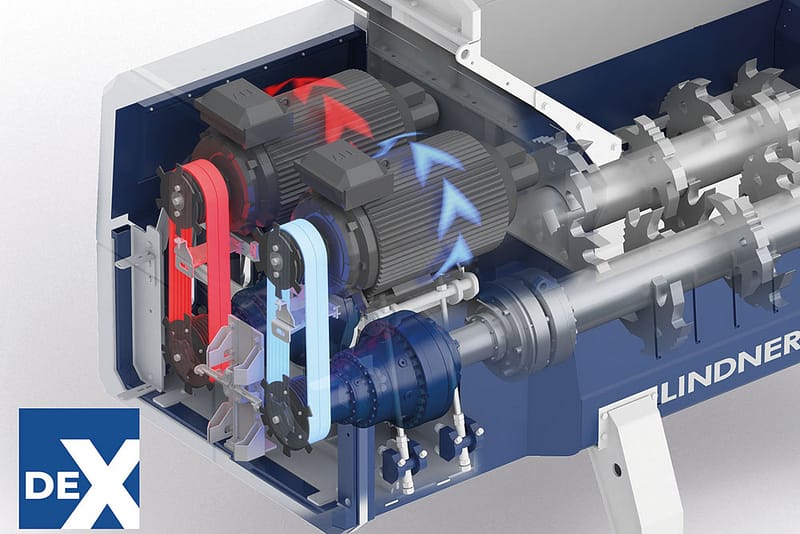
- Automatic belt tensioning
- Dust-protected drive technology
- Updated software
- Improved controls
- Easier maintenance access
Lindner describes the Komet range as a benchmark in secondary shredding, particularly for applications involving the production of high-calorific Solid Recovered Fuel (SRF).
For operators producing RDF or SRF, consistent secondary shredding is essential for achieving the required fuel specification.
Shredding Technology for SRF and RDF
The production of SRF and RDF is one of the most important applications for industrial shredders.
Waste materials that cannot be economically recycled as materials can potentially be processed into alternative fuels.
A typical process can involve:
Mixed Waste
↓
Primary Shredding
↓
Sorting & Separation
↓
Secondary Shredding
↓
SRF / RDF Production
The quality of the final fuel depends on the complete processing system rather than simply the shredder.
This is why Lindner’s approach extends beyond individual machines into complete waste processing and recycling solutions.
Mobile Shredding Technology
Mobile shredders provide waste operators with an additional level of flexibility.
Rather than transporting all waste to a fixed processing line, mobile equipment can be positioned closer to the material being processed.
Lindner’s mobile shredding portfolio includes the Urraco range, designed for demanding applications including:
- Waste wood
- Bulky waste
- Commercial waste
- Construction and demolition waste
- Plastics
- Scrap
- Railway sleepers
Lindner’s Urraco 4000 generation, for example, was introduced with diesel and optional electric-drive configurations, alongside features designed to simplify maintenance and maximise uptime.
The Evolution of the Urraco
Lindner’s mobile shredder technology has continued to develop since the original Urraco models.
The Urraco 4000 series was developed with a focus on versatility, low maintenance and energy efficiency, while retaining the twin-shaft technology associated with the Urraco range.
More recently, Lindner has introduced the Urraco Evo generation, designed for heavy-duty applications and offering quick-change functionality and different shaft configurations.
This evolution demonstrates how shredder technology continues to adapt to changing requirements within the recycling industry.
Innovations in Plastics Recycling
Shredding also plays an important role in plastics recycling.
The preparation of plastic waste can influence the performance of downstream:
- Sorting
- Washing
- Separation
- Granulation
- Extrusion
Lindner has developed integrated plastics recycling solutions covering processes from shredding through to sorting and washing.
This is particularly important as recyclers face increasing demand for higher-quality recycled materials.
The objective isn’t simply to reduce the plastic into smaller pieces.
The entire process needs to be carefully coordinated to maximise recovery and minimise contamination.
Preparing Plastics for High-Quality Recycling
The quality of the material produced during shredding can have a significant effect on downstream sorting.
Lindner’s Jupiter BW series, for example, was developed specifically for film recycling and uses a specialised shredding configuration designed to reduce fines while producing more consistent particles for subsequent NIR sorting.
This illustrates an important principle of modern recycling technology:
Shredding performance should be designed around the requirements of the complete processing line.
The Future of Recycling Technology
The recycling industry is moving towards increasingly integrated processing systems.
Future waste processing plants are likely to place greater emphasis on:
Energy Efficiency
Reducing energy consumption per tonne processed.
Automation
Reducing manual intervention and improving consistency.
Data
Using machine and process data to identify opportunities for improvement.
Maintenance
Predicting and preventing failures before they cause significant downtime.
Flexibility
Processing a wider range of materials with fewer machine changes.
Resource Recovery
Maximising the amount of valuable material recovered from waste.
Lindner’s latest developments reflect many of these trends.
At IFAT 2026, the company highlighted technologies including the new Urraco Evo, Merak 2800, fourth-generation Micromat and its Nexus digital service platform for performance monitoring and plant availability.
Lindner Shredders for Modern Waste Processing
The continued development of Lindner shredding technology demonstrates how shredders are becoming increasingly sophisticated components within wider recycling systems.
Whether the requirement is:
- Primary shredding
- Secondary shredding
- Waste wood processing
- Plastics recycling
- Scrap processing
- SRF production
- RDF production
- Bulky waste processing
- Mobile shredding
the machine needs to be matched to the specific application.
The correct shredder configuration can have a major impact on throughput, energy consumption, wear rates and the quality of the final output.
Mach Tech Services, Lindner Shredding Technology in the UK & Ireland
Mach Tech Services is the sole distributor of Lindner Recyclingtech shredders in the UK and Ireland.
We provide Lindner shredding technology for a wide range of applications, including:
- Waste wood recycling
- Plastics recycling
- Metal recycling
- SRF production
- RDF production
- Bulky waste
- Commercial and industrial waste
- Construction and demolition waste
Our support extends throughout the life of the machine.
Mach Tech provides:
- Application consultation
- Machine installation
- Commissioning
- Preventative maintenance
- Breakdown support
- Genuine spare and wear parts
- Precision engineering
- Welding
- Hardfacing
- Full shredder rebuilds
We also hold over £1 million worth of spare and wear parts in stock, helping customers reduce downtime when components need replacing.
Looking for Lindner Shredding Technology?
If you’re considering investing in a new industrial shredder, upgrading an existing recycling system or looking for a more efficient way to process waste, Mach Tech Services can help.
Our team can assess your material, throughput requirements and desired output before recommending the most appropriate Lindner shredding solution.
Call Mach Tech Services on 01706 838 246 to discuss your requirements.
Frequently Asked Questions
What is Lindner shredding technology?
Lindner shredding technology refers to the range of industrial shredders and processing solutions developed by Lindner Recyclingtech for applications including waste processing, recycling, alternative fuel production and material recovery.
What materials can Lindner shredders process?
Depending on the machine and configuration, Lindner shredders can process materials including waste wood, commercial and industrial waste, municipal waste, plastics, bulky waste, scrap metal and materials used for RDF and SRF production.
What is the difference between primary and secondary shredding?
Primary shredding reduces large or bulky incoming waste into a more manageable size. Secondary shredding further reduces and refines the material, often to meet a specific output or fuel specification.
Are Lindner shredders suitable for SRF production?
Yes. Lindner offers primary and secondary shredding technologies specifically suited to waste processing and SRF production. The Komet range is particularly associated with secondary shredding for high-calorific SRF.
Are Lindner shredders suitable for waste wood?
Yes. Lindner produces stationary and mobile shredders for a wide range of waste wood applications, including demanding timber streams.
Does Lindner manufacture mobile shredders?
Yes. Lindner’s mobile range includes the Urraco and Merak families, with different machine configurations designed for different waste streams and operating requirements.
What was showcased at IFAT?
Lindner has used IFAT to showcase numerous innovations across its product range. At IFAT 2024, highlights included the Merak universal shredder, Alcor stationary twin-shaft shredder and new Komet knife-holder technology.
Why is maintenance important when choosing a shredder?
Maintenance requirements directly affect machine availability and operating costs. Features that improve access to wear parts and simplify repairs can reduce downtime and help keep a recycling plant operating efficiently.
Can Lindner shredders process plastics?
Yes. Lindner develops shredding and complete processing solutions for plastics recycling, including systems incorporating shredding, sorting and washing.
Can Mach Tech supply Lindner shredders in the UK?
Yes. Mach Tech Services is the sole distributor of Lindner Recyclingtech shredders in the UK and Ireland.
Find Your Ideal Shredding Solution, Speak to Our Experts
Looking for the right setup for your operation or need guidance on applications, throughput or particle size? Our specialists are here to help.
Whether you’re exploring the capabilities of the Lindner shredder range or comparing shredding solutions, we’ll work with you to identify the best fit for your needs.
Call us today on 01706 838 246, or get in touch for expert advice, pricing, or to arrange a site visit.
You can also use the form to send your enquiry and a member of our team will be in touch shortly.
"*" indicates required fields